






WW2 German SA Dagger by Aesculap – Rare Maker
$1,200.00 CAD
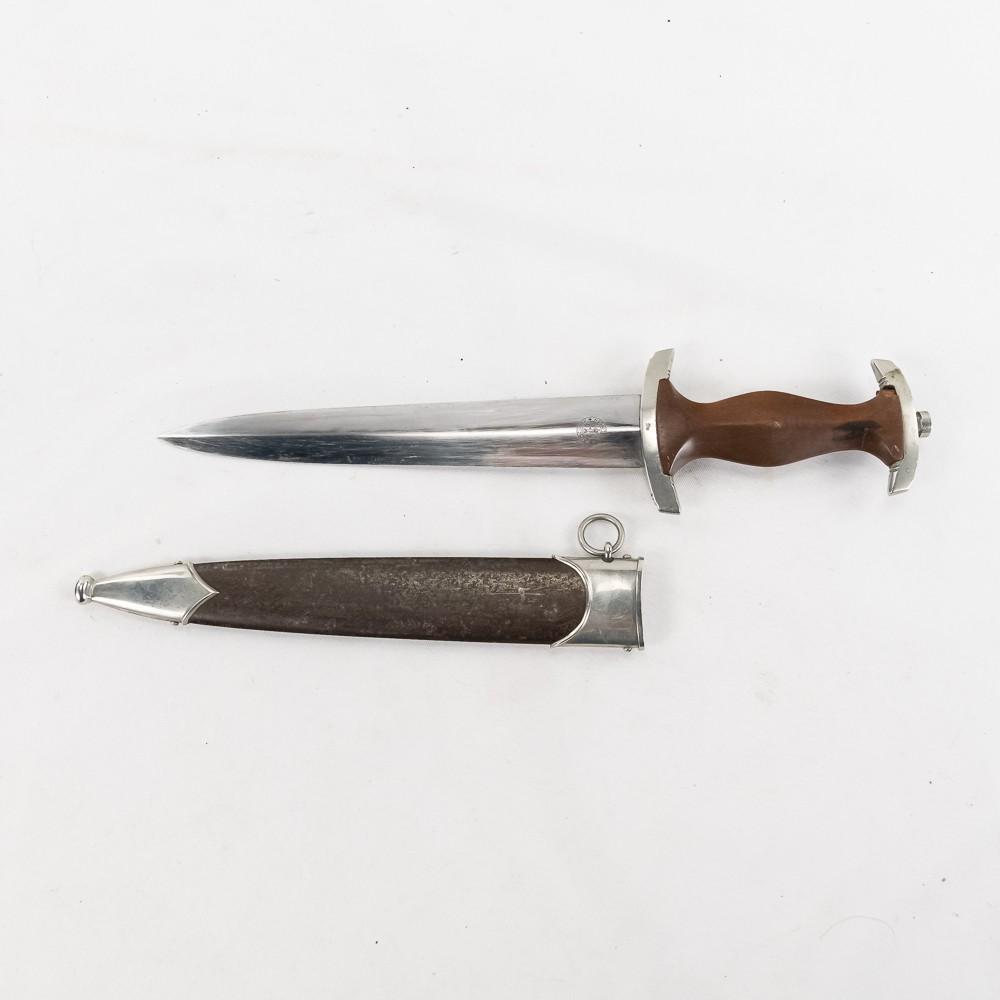
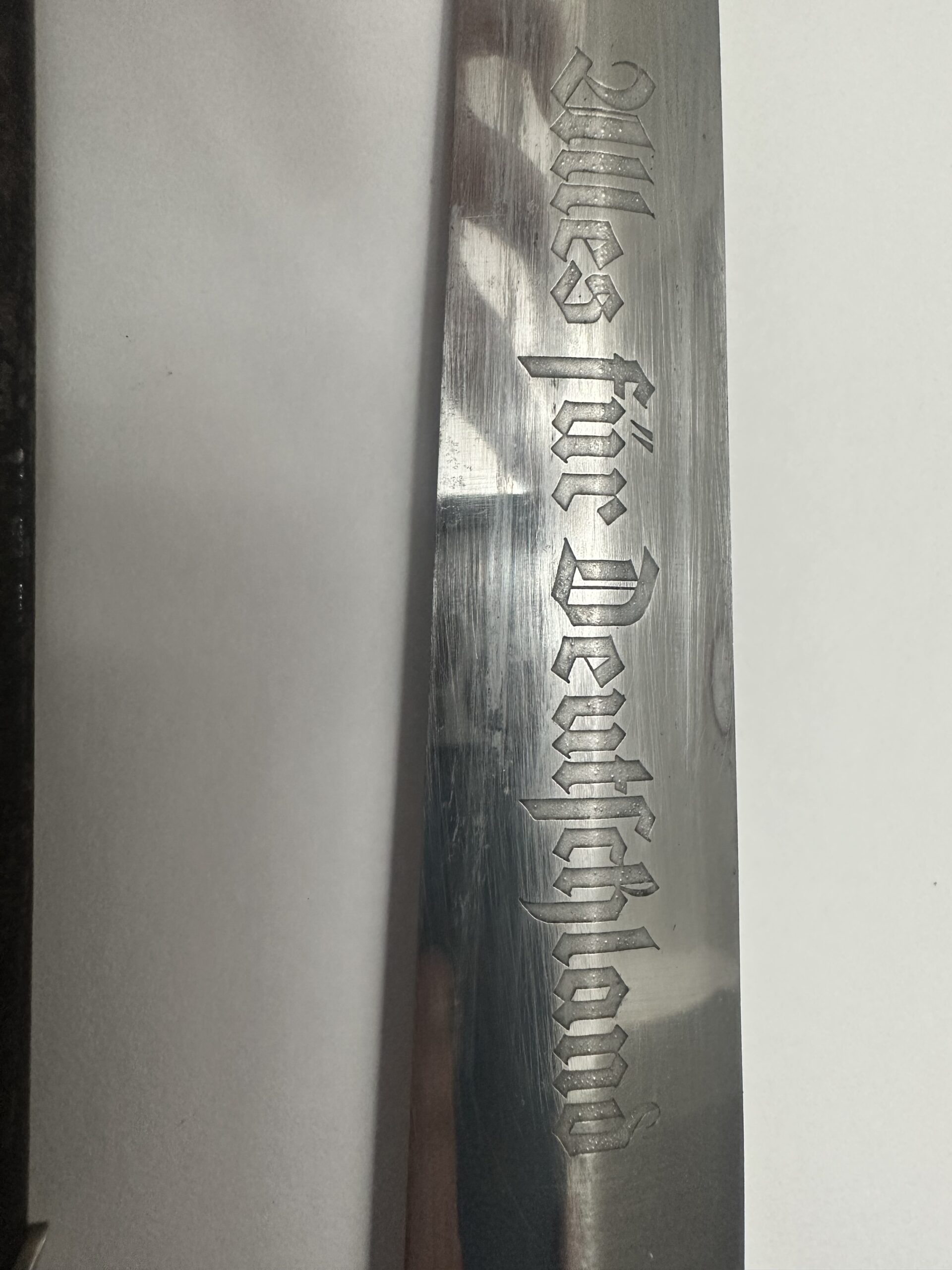
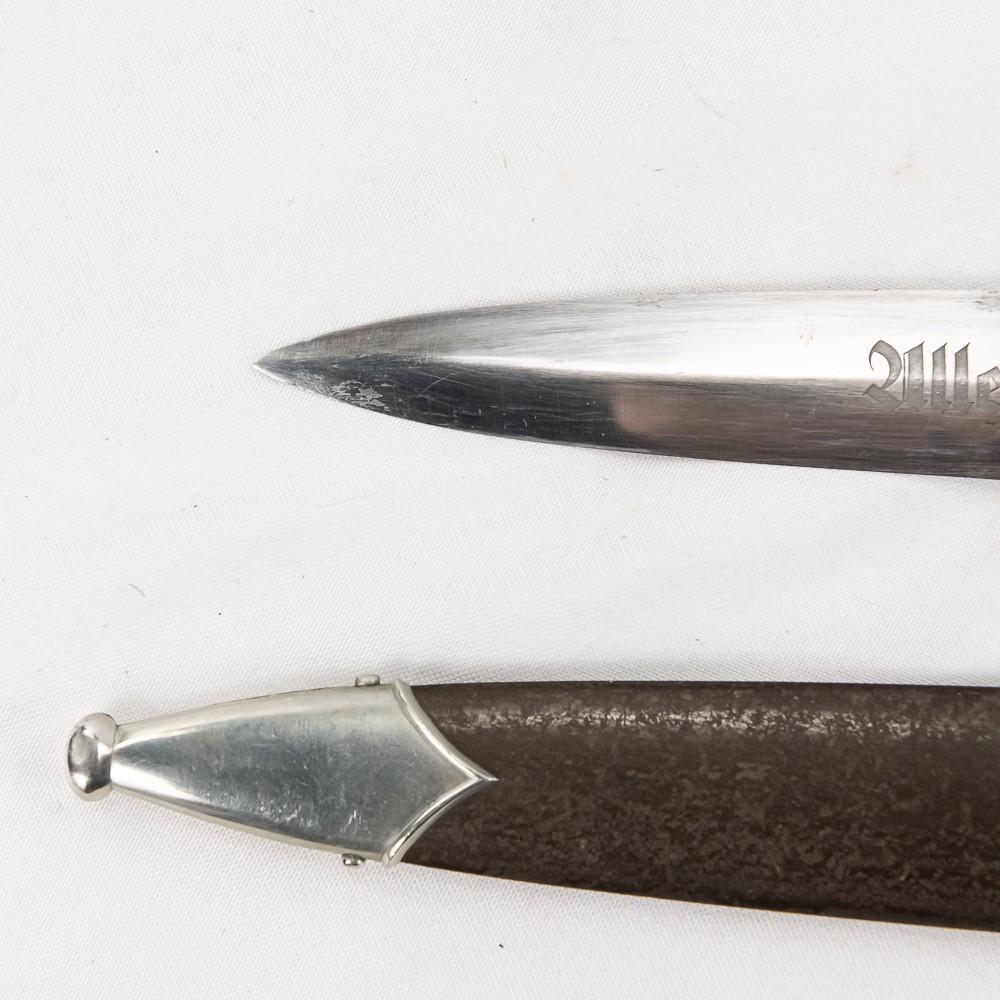
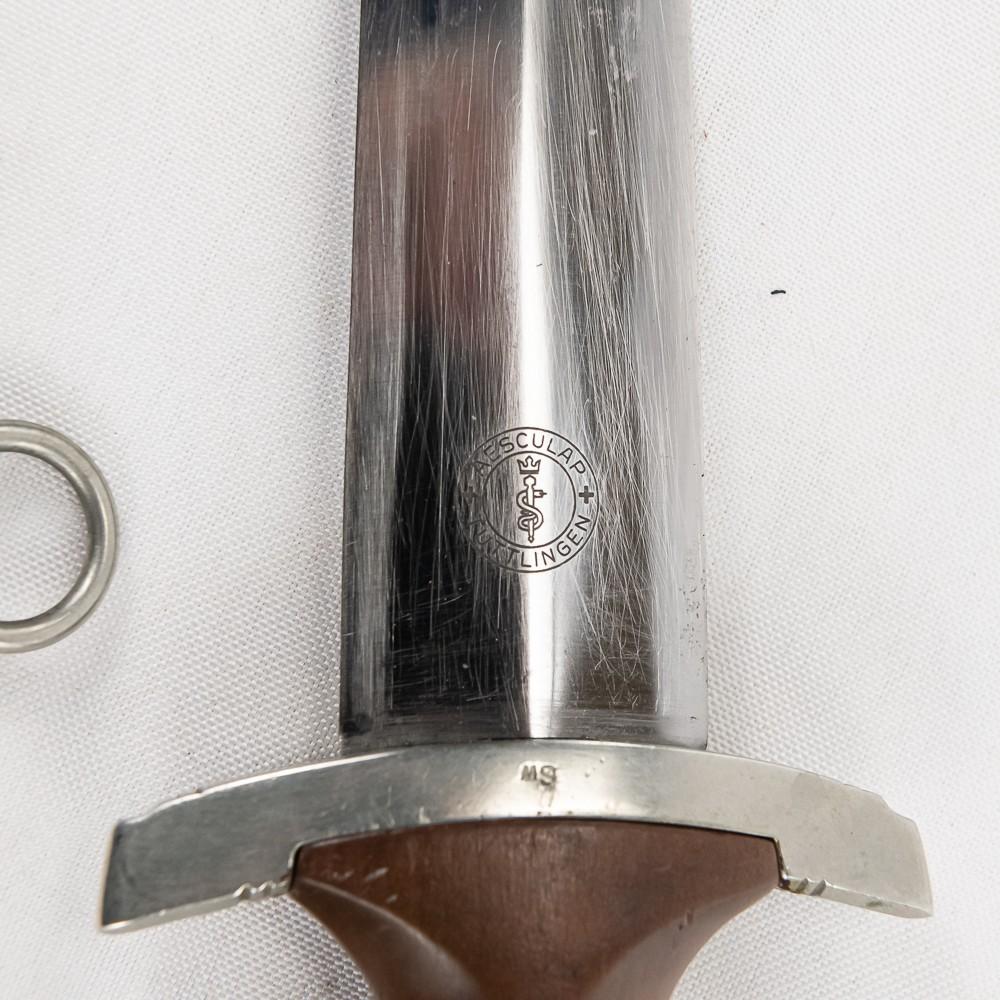
This early SA Dagger has the full Aesculap logo. The blade is bright with very crisp motto. The blade shows in/out wear and wear. The grip has a small crack and issue at the top. The anodized scabbard shows wear to the paint and has one small ding to scabbard tip. Just another solid example of an early SA dagger.
AESCULAP HISTORY: Aesculap is a renowned German company specializing in surgical instruments and medical technology. The company was founded in 1867 and is headquartered in Tuttlingen, Germany. It takes its name from Aesculapius, the Greek god of medicine and healing.
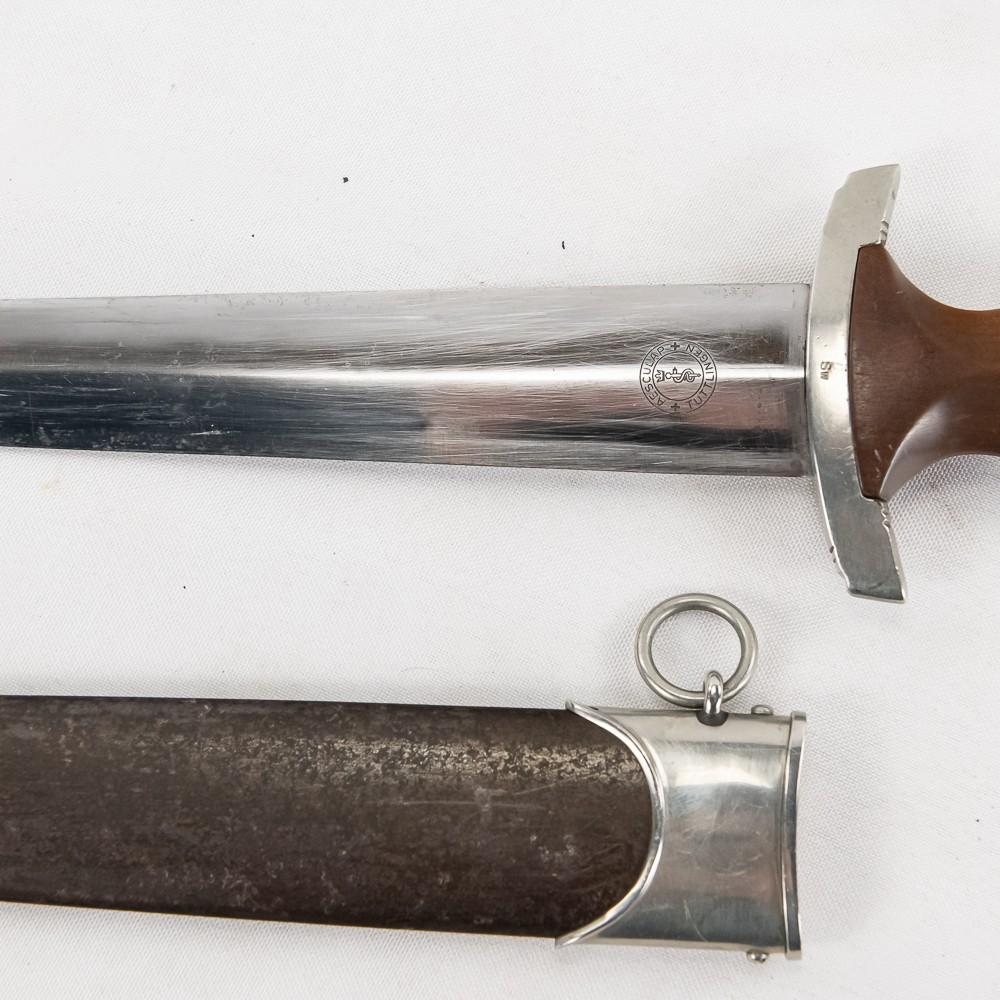
AESCULAP (CROWN) + (Rod of Aesculapius) + TUTTLINGEN
Per J. Anthony Carter’s book GERMAN KNIFE AND SWORD MAKERS, this firm was originally founded by Gottfried Jetter in 1867, and in 1887 he partnered with the Scheerer brothers to form Jetter & Scheerer. By 1895, they recognized the limitations of a family business, and formally incorporated. They built a new factory and registered the trademark Aesculap. The company used this particular “round” trademark on very early SA and NSKK daggers, which they made only made a very small number of.
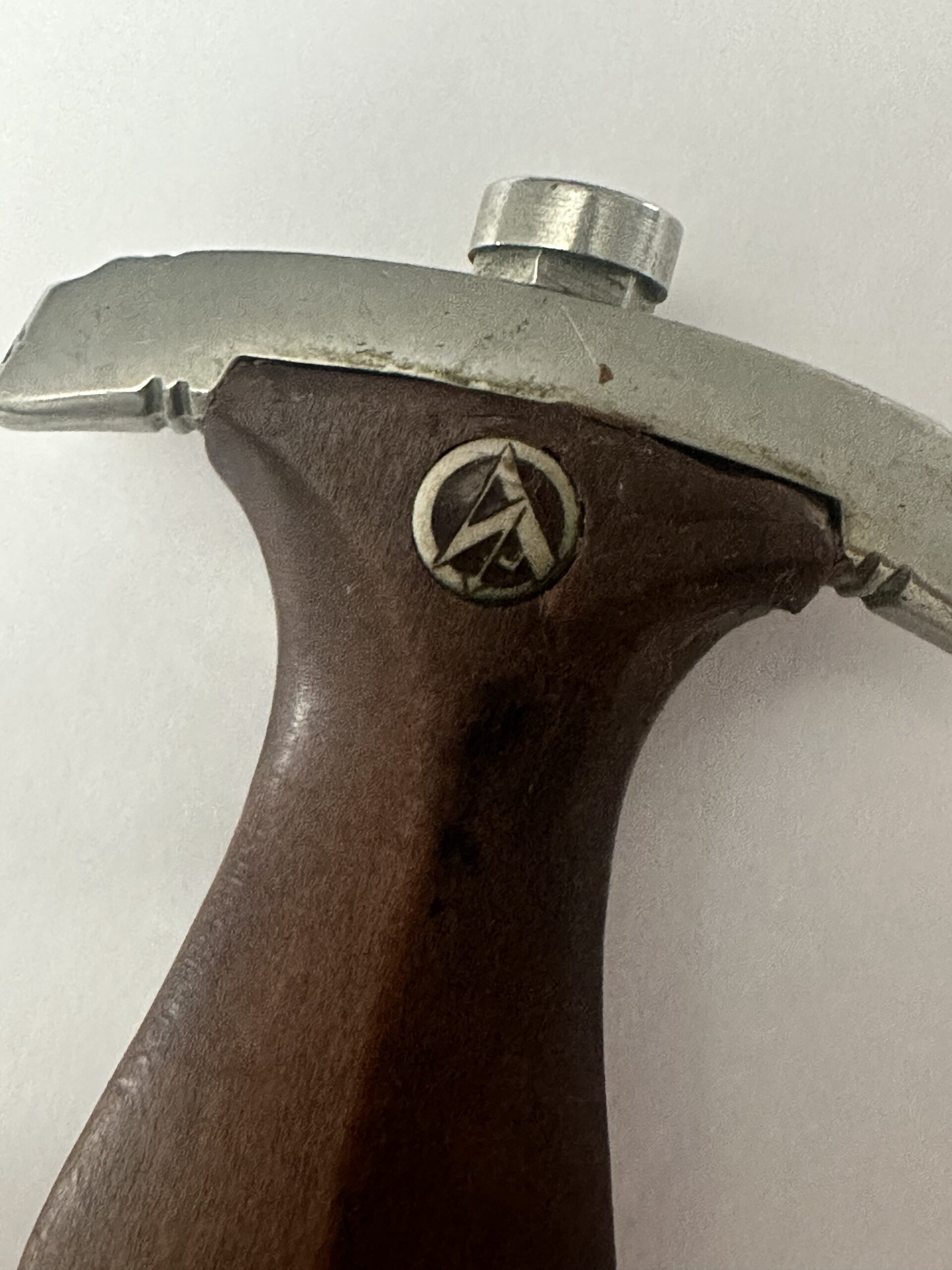
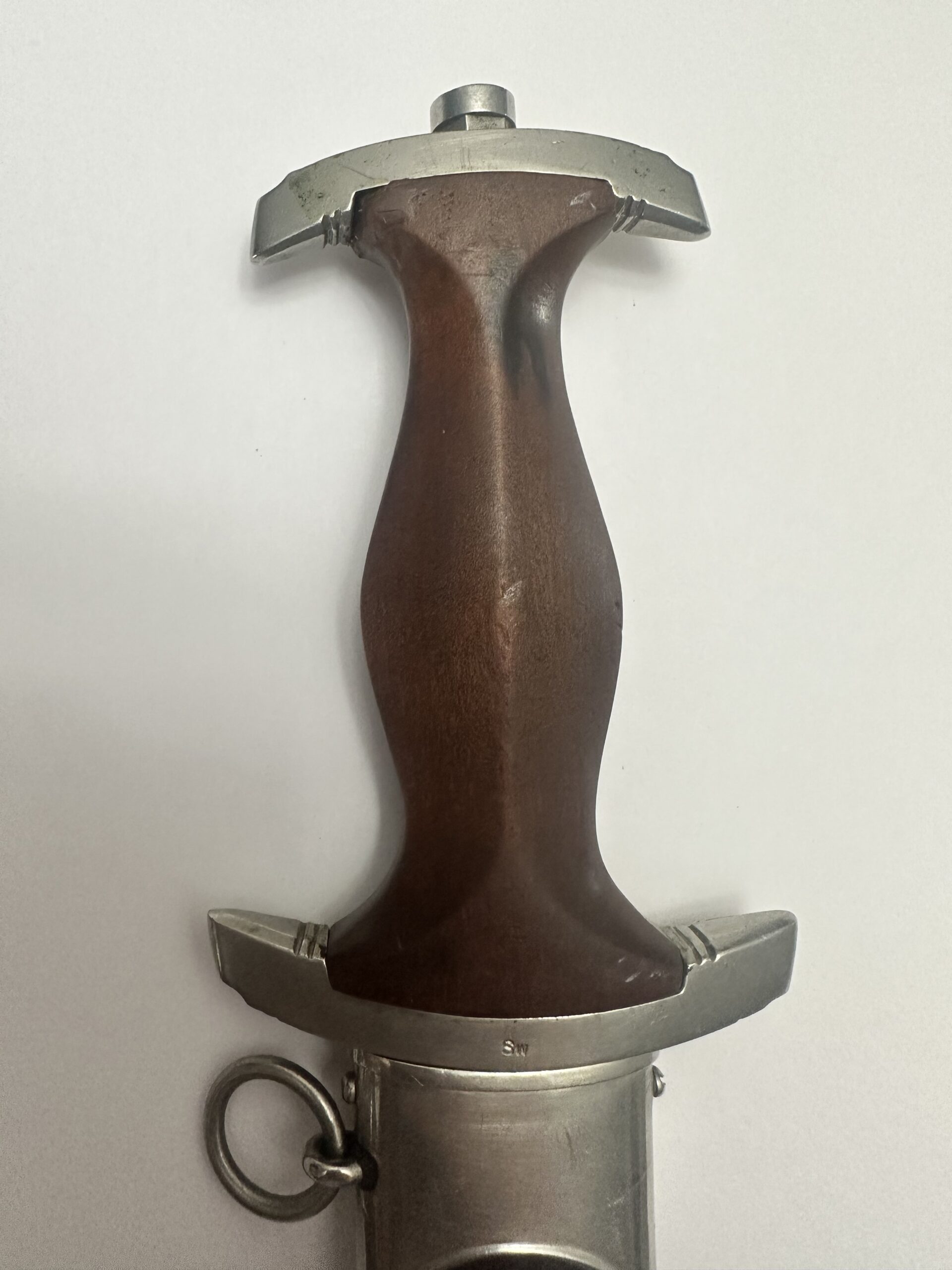
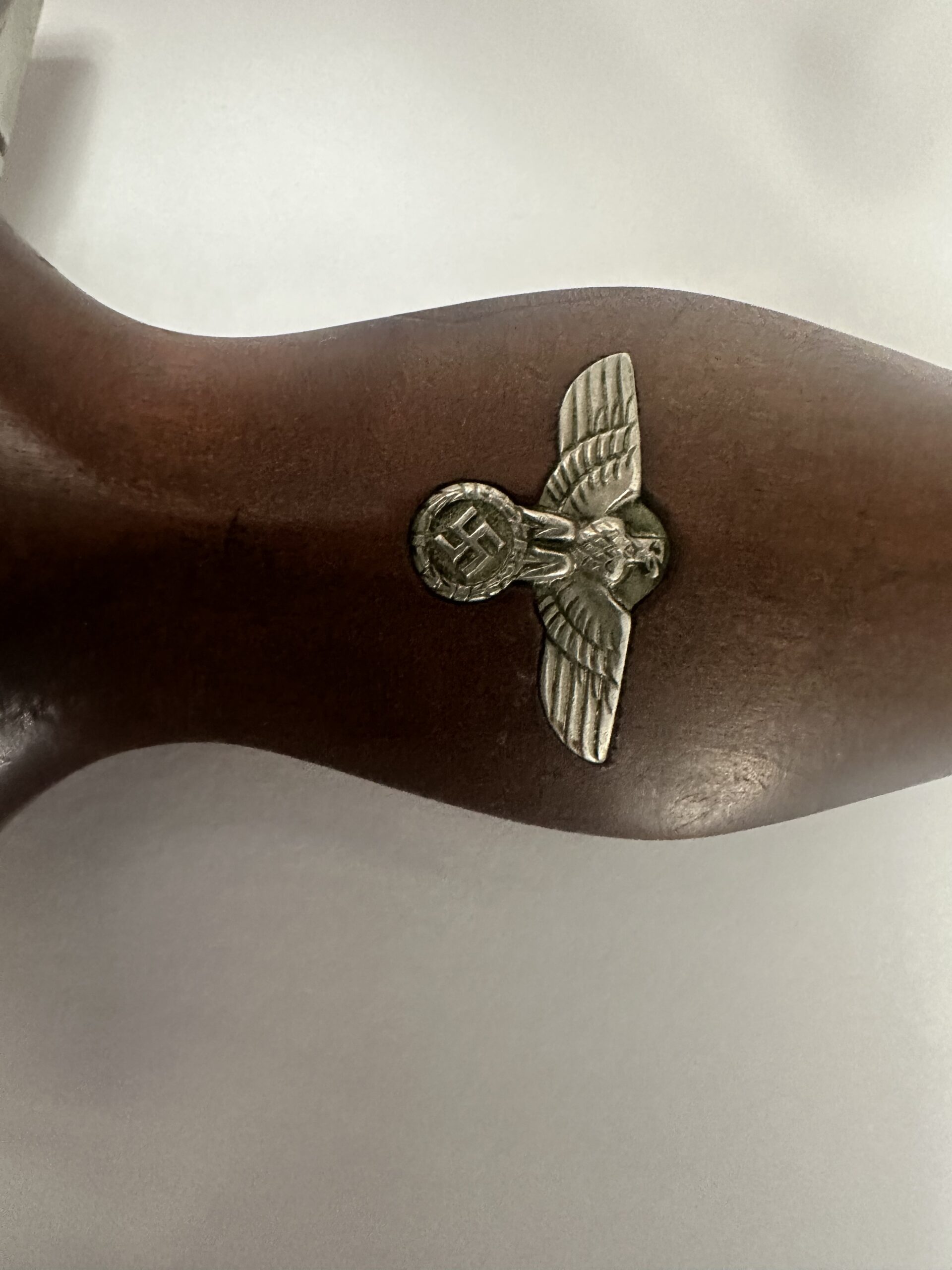
The brown hardwood grip has a small crack and one issue, but no major damage, just the usual wear to the finish from age and use. The solid nickel-silver eagle is crisp with a perfect fit. The SA roundel also has a good fit and retains most of the enamel. The pommel and cross guard are fine solid nickel silver examples, still tight to the grip, with the expected wear from age and service.
The lower reverse guard is Gruppe/Gau marked Sw, or Sudwest (South West) a district in far South West Germany, with the principal city being Stuttgart. This feature was only seen on daggers produced 1935 and prior.
The scabbard shell is straight throughout and is the early-war style, which were produced with a brown “anodized” finish on the steel, which was then lacquered. It still retains much of the original finish. This is definitely one of the better examples we have seen, with no dents on the body we can see, and lots of the original anodized finish intact. The upper and lower fittings are solid nickel silver, with a great look and some dents and scratches showing typical wear. The chape is lightly dented at the end, though not split, as the nickel alloy is somewhat soft, a common thing to see. The throat nicely matches the crossguards, and all fittings have their original dome headed screws.
A very interesting early SA dagger, marked by a rare maker. Ready to add to your collection and display!
Specifications: Blade Length: 8 3/4″ Overall length: 13 3/4” Crossguard: 3” Scabbard Length: 10”
SA HISTORY: The SA or Brown Shirts, were a private political formation which AH and the NSDAP used to maintain order at organized Party meetings and demonstrations. The group was formed in 1921, and grew to a huge force of nearly 3,000,000 men by the later 1930’s. To instill esprit de corps, as well as create employment for the Blade City of Solingen, it was decided each SA man would carry a dagger with his Brown Shirt uniform. Huge quantities needed to be produced to accommodate the demand. The dagger initially was produced of hand-fitted nickel mounts with attractive finished wood grip and brown anodized (a bluing process) finished scabbard.
The blade was etched with the SA motto, Alles für Deutschland. Examples produced prior to 1935 were stamped with the German sector of the SA group on reverse lower crossguard. Later examples underwent standardization through the RZM ministry. These pieces were produced of cheaper plated zinc-base fittings and scabbards were simply painted brown.
SA GRUPPE SW HISTORY: The SA Gruppe Sudwest, or SA Group Southwest, was one of the regional divisions of the Sturmabteilung (SA), which was the paramilitary organization of the Nazi Party in Germany. The SA was founded in 1920 and played a significant role in the early years of the Nazi Party’s rise to power.
The SA Gruppe Sudwest encompassed the southwestern region of Germany, specifically covering the states of Baden, Palatinate, and Saarland. It operated under the command of a high-ranking SA officer known as a Gruppenführer.
The SA was involved in various activities, including political rallies, providing security at Nazi Party events, and engaging in street battles with political opponents. During the 1920s and early 1930s, the SA played a crucial role in enforcing Nazi Party ideology and intimidating political adversaries.
However, after AH became Chancellor in 1933, the SA’s influence began to decline as the Nazi regime consolidated power. In the Night of the Long Knives in 1934, Hitler ordered the purging of the SA leadership, resulting in the imprisonment and execution of many SA leaders. This event marked a significant turning point for the SA’s role within the Nazi Party and the broader political landscape.