






IMPERIAL GERMAN MODEL 1898 QUILLBACK BAYONET S.98nA
$680.00 CAD
Description
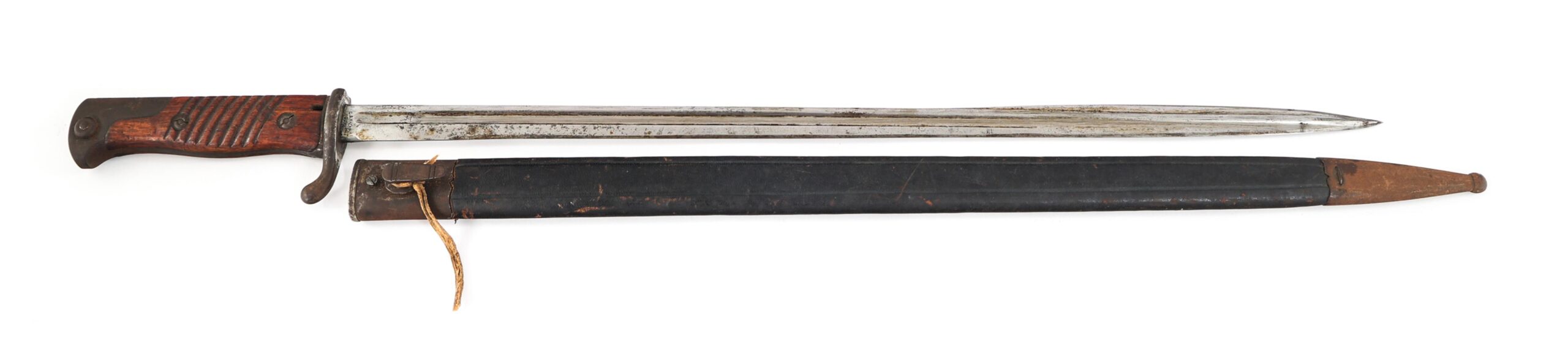
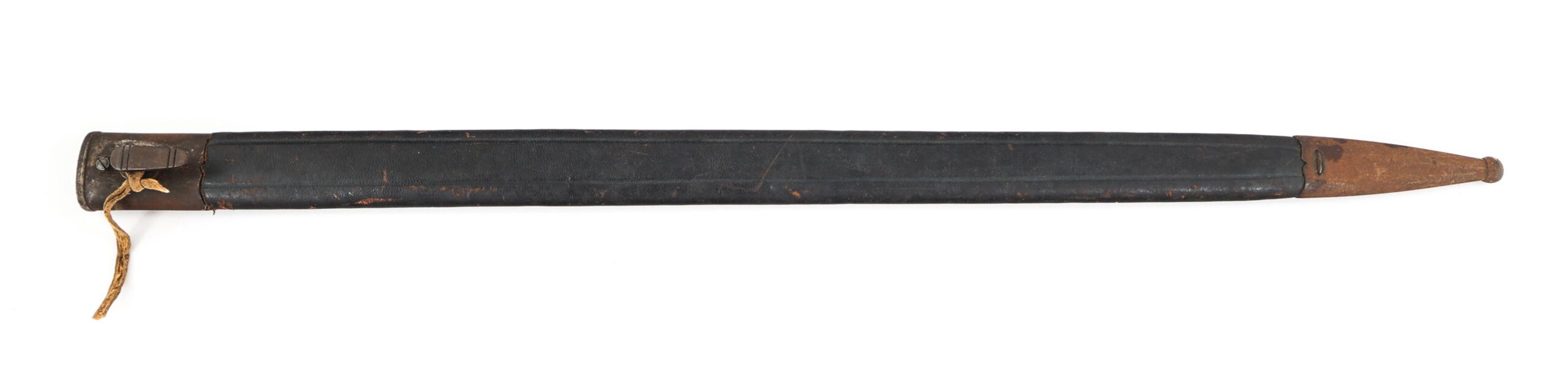
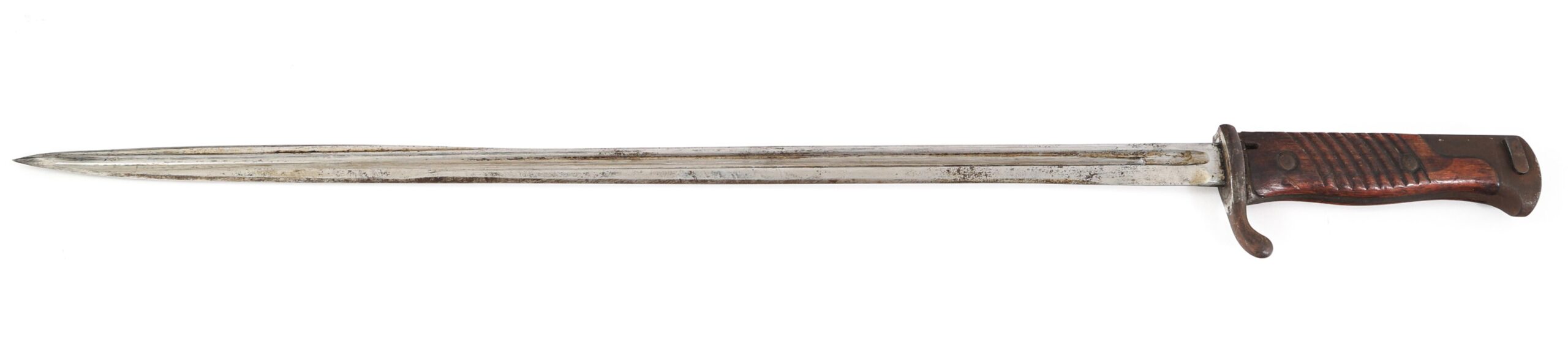
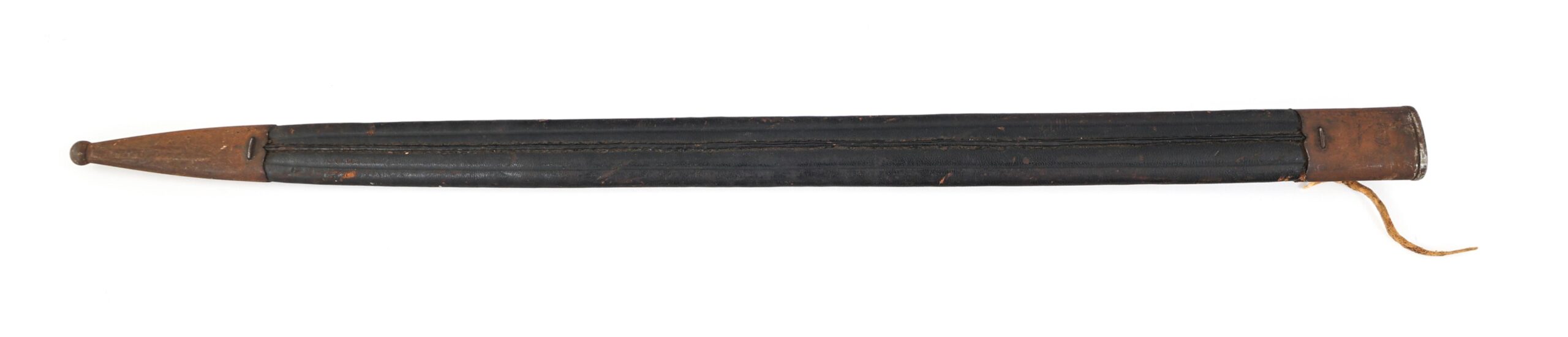
Imperial German Model 1898 Sword Bayonet. Single edged, quill-back, bright blade with fuller. Maker marked by C.G. Haenel, Suhl on one side of the ricasso. Steel hilt with wood grips. Leather covered scabbard with steel fittings. Blade Length: 20 1/2″ Total Length: 26″
Condition Report
C. G. Haenel Info:
The history of C. G. Haenel traces back to 1840 when Carl Gottlieb Haenel, the Prussian commissioner for firearms manufacturing, diversified into producing bicycles and weapons. This dual focus was common at the time due to shared means of production and skills. In 1887, weapons designer C. W. Aydt collaborated with the company to produce his target rifle and later the Aydt target pistol. Haenel’s involvement in manufacturing expanded with the introduction of the M1879 Reichsrevolver for the German Army in 1879.
During the 1920s, Hugo Schmeisser joined the company, leading to the production of pocket pistols and the development of automatic submachine guns, such as the MP28 in 1928. Despite Hugo Schmeisser’s success, the company faced bankruptcy several times between 1929 and 1934. In 1933, it formed the United Suhl-Zella-Mehlisser Arms Factories association to secure armament contracts from the Nazi government.
In 1935, the lead-up to World War II witnessed a significant surge in arms production, resulting in the development of a new automatic firearm featuring an intermediate cartridge. This innovative weapon, initially designated the Mkb 42(H) and later known as the MP43, chambered in 7.92×33mm, was designed to surpass the Erma Werke MP38/MP40 submachine gun. Its distinguishing features included higher performance, an economical design, and the utilization of an advanced factory stamping technique. By 1943, over 10,000 units had been produced, but production was abruptly halted that same year on the orders of Adolf Hitler. After successful testing with troops, Hitler subsequently sanctioned mass production, and upon entering service, the firearm earned the designation Sturmgewehr 44 (StG 44).
In the 1950s, following the defeat of Nazi Germany in World War II, U.S. forces briefly occupied Suhl, imposing a temporary ban on arms factory production. Subsequently, after the withdrawal of American troops, the area came under Soviet occupation, eventually becoming part of East Germany. As part of war reparations, approximately 50 StG 44 rifles were transferred to the Soviet Union, along with 10,785 weapon blueprints. The company underwent consolidation and emerged as the VEB Vehicle and Hunting Weapons Factory “Ernst Thälmann” (German: VEB Fahrzeug- und Jagdwaffenwerk „Ernst Thälmann“). Under the brand name Haenel Suhl, the company shifted its focus to producing air rifles and hunting carbines.
In 2008, the company was reestablished as C. G. Haenel and became part of Merkel, which is a subsidiary of Caracal International in the United Arab Emirates. The recent years have seen the introduction of various products, including the Haenel RS8 sniper rifle in 2008 and the Jaeger 8 series of hunting rifles. In 2016, the Bundeswehr ordered the Haenel RS9 as its new medium-range sniper rifle.
In 2019, the MK 556 assault rifle was shortlisted as a potential replacement for the Bundeswehr’s G36 service rifle, and despite initial expectations, it was selected in 2020. However, the award decision was withdrawn in October 2020, leaving the G36 replacements uncertain. In 2021, the Jaeger NXT straight-pull rifle was introduced, featuring a unique linear motion mechanism for chambering and extracting cartridges.
S.98nA Bayonet info:
The 1898 Mauser “Quillback” bayonet is a distinctive bayonet designed for use with various models of Mauser rifles, particularly the Mauser Gewehr 98 (G98) rifle. Here’s some information about it:
Design: The “Quillback” nickname comes from the distinctive shape of the bayonet’s cross-section, which resembles a quill or a triangle. It features a blade with a fuller (a groove running along the flat of the blade) and a distinctively shaped crossguard.
Compatibility: The 1898 Mauser Quillback bayonet was designed to fit the Gewehr 98 rifle, which was the standard infantry rifle of the German Army during World War I. However, it may also fit other Mauser rifles with similar bayonet lugs.
Length: The bayonet typically has a blade length of around 20 inches (50 centimeters), though there may be slight variations depending on the specific model and manufacturer.
Manufacturers: Various manufacturers produced these bayonets, including Weyersberg, Kirschbaum & Co. (WKC), Alex Coppel (Alcoso), and E. & F. Hörster.
Markings: The bayonets often bear markings indicating the manufacturer and sometimes the year of production. These markings can help identify the bayonet’s origin and authenticity.
Use: Bayonets were primarily used as close-quarters combat weapons and as utility tools for tasks such as cutting foliage or opening cans.
Collectability: Like many historical military artifacts, 1898 Mauser Quillback bayonets are sought after by collectors due to their historical significance and unique design. Condition, markings, and rarity can all influence the value of a particular bayonet.
Authentication: If you’re purchasing or evaluating a 1898 Mauser Quillback bayonet, it’s important to ensure its authenticity through careful examination of markings, dimensions, and overall construction. Consulting with knowledgeable collectors or experts can also be helpful in verifying authenticity.