



British Officer Sword George III 1796 Pattern – General Staff Gilded Scabbard
$2,100.00 CAD
NAPOLEON WARS BRITISH INFANTRY OFFICER 1796 PATTERN GENERAL STAFF SWORD. GILDED.
One of the rarest swords in modern British military history, especially with the gilded scabbard
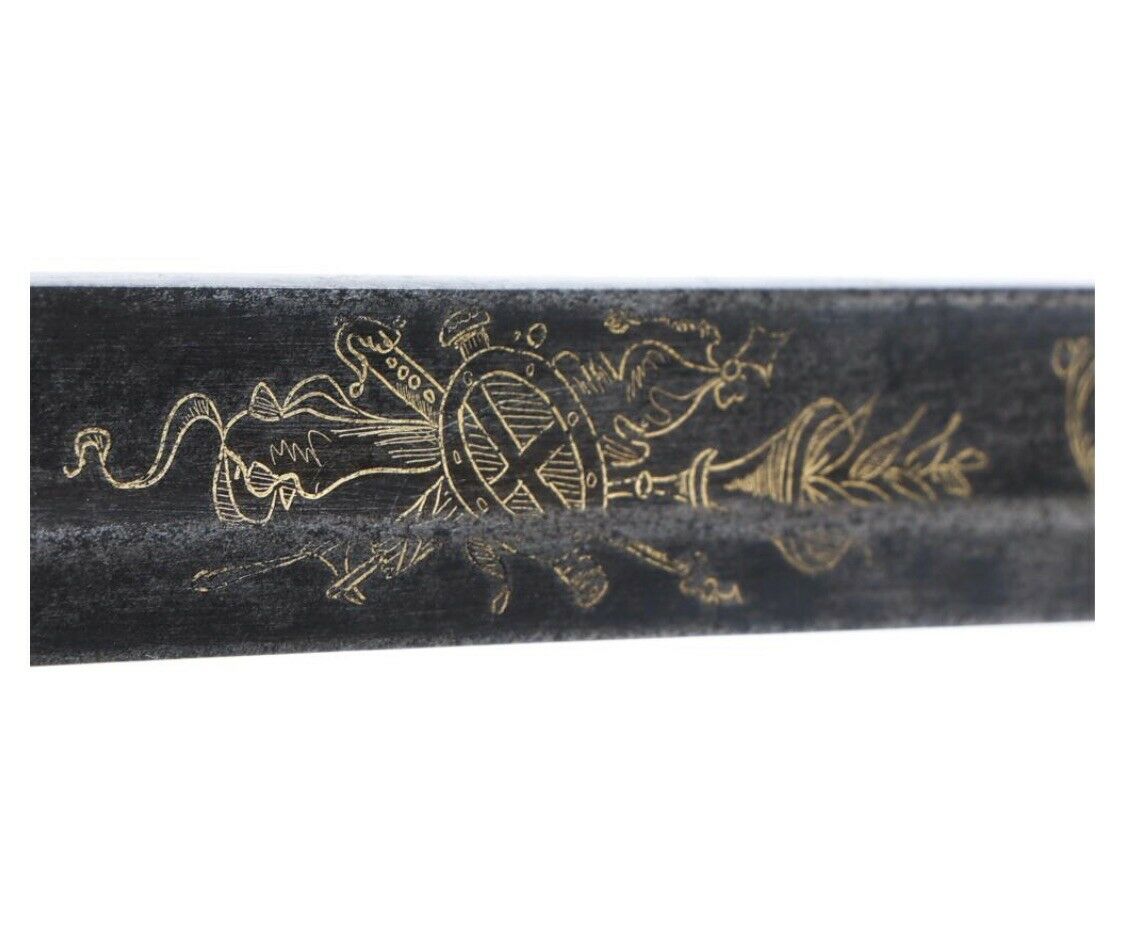
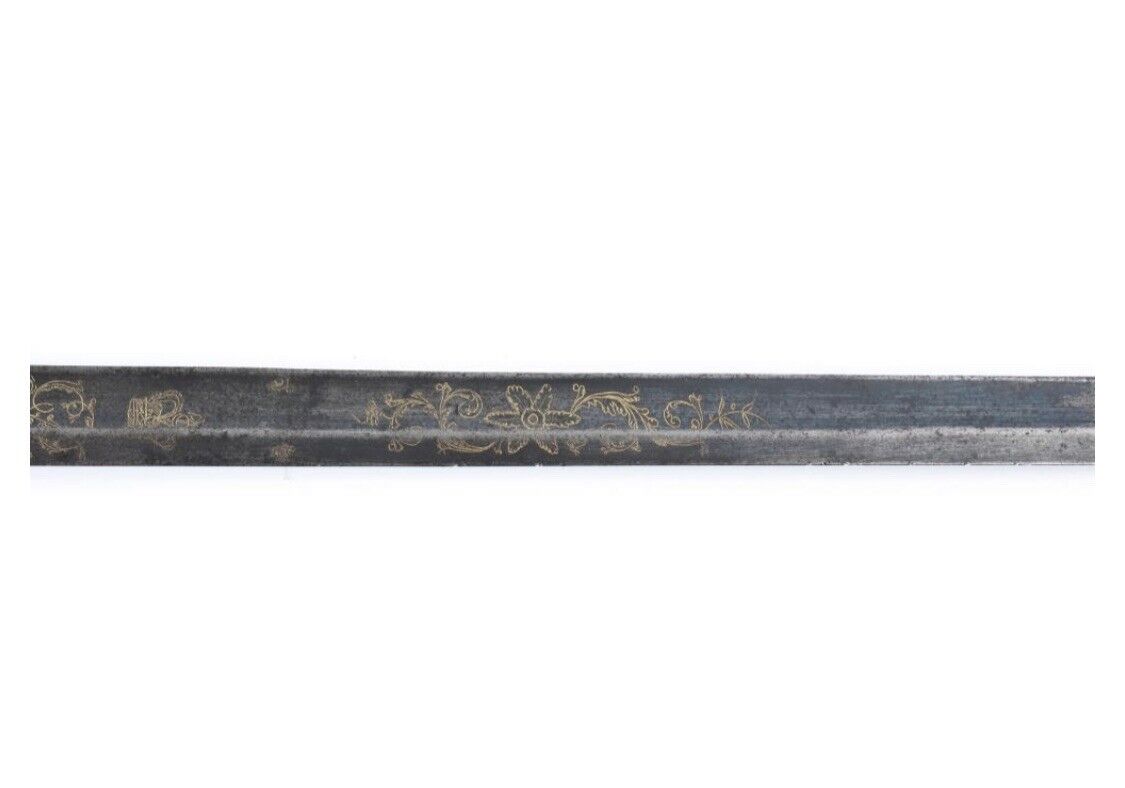
BRITISH INFANTRY OFFICER 1796 PATTERN SWORD | British Infantry Officer 1796 Pattern Sword. Single edged, straight blade with fuller, dry-point etched with gold washed floral & regimental Coat-of-Arms decoration. Gilded brass hilt with Urn-shaped pommel and fold-down reverse guard. Wood grip. Gilded brass scabbard.
Blade Length: 32″
Total Length: 38.5″
The gilded scabbard version of this sword is by far the rarest. Only going to Generals staff and high ranking officers, most of the examples seen are the leather or metal scabbard.
Condition Report:
Very good.
Until 1786, British infantry officers were required to carry spontoons as symbols of their ranks, and no standard pattern of sword existed. However, the spontoon proved to be impractical during the American War of Independence (1775-83), and they were eventually abolished for officers in favour of a general form of sword.
Between 1786-96, officers were required to purchase their own swords, and due to a lack of detail in the regulations they had some degree of choice, as long as a specific regimental pattern was not demanded by their commander.
The sword only had to be a straight cut-and-thrust blade, at least 32 in long and 1 in wide at the shoulder. However, the form of neither the hilt or the blade was specified; the only demand being that the colour of the metal match the colour of the buttons of the officer’s uniform. Nevertheless, most officers opted for a spadroon hilt, with a straight knuckle guard and beaded side ring, and a flat-backed blade with a single-edge and fuller.
In 1796 a new sword was prescribed for infantry and field (foot) artillery officers, with sergeants carrying a simpler and unadorned version of the same sword. The hilt with double shell guard was in essence a simplified form of small-sword hilt, the standard civilian sword of the gentry of Europe for the 18th century, and hence would have been a type of sword with which most officers would have been familiar. However, military versions, like the 1796 Infantry Officer’s sword, often lacked the arms of the hilt, through which the user could loop the forefinger to gain better control of the needle-like point of a true small-sword.
Use and Effect
Although of a form familiar to its users, and a type used broadly all over Europe by infantry officers of various nations, the sword was not overly suited to military fighting. The shell guard, although offering theoretical protection to the hand, was rather weak and unlikely to protect against a determined strike from a much heavier cavalry sword or even a musket barrel. The guards were often hinged, so that the sword would lie flat against the side of the body when worn and not rub the fabric of the uniform, but this further weakened the sword. Furthermore, it lacked sufficient mass to be able to effectively parry attacks from heavier bladed combat swords, of the type used by French cavalry.
The lack of a clear directive on the form of the blade allowed a variety of blade forms to be used. Nevertheless there was still very much a favoured type. The most common blade type was also rather light for the cut-and-thrust purpose it was designed for. Whilst this made for a light and agile sword, the broad fuller extending the full length of the blade meant that the sword lacks stiffness for thrusting whilst its straight narrow blade would have been indifferent at cutting.
However, despite its flaws the sword could be used as a lethal weapon when necessary. At Waterloo, Captain Adair of the 1st Foot Guards was able to dispatch a cuirassier officer who used a breach caused by artillery to penetrate the battalion’s square. Also, Ensign Clarke of the 69th Foot was able to kill three cuirassiers during the battle, but the fact that he received 22 wounds in doing so perhaps speaks more of his personal fortitude than the merits of the sword.
*With documentation.