


Antique 16th Century Japanese Katana Made By Famed “Owari Three Master Swordsmiths” – NBTHK Hozon – Hida No Kami Ujifusa
$10,000.00 CAD
The Blade (NBTHK HOZON): HIDA NO KAMI UJIFUSA
The NBTHK papered blade displays a graceful shinogi-zukuri form with a well-defined shinogi line and a bright, reflective polish. The hamon is notably active, formed in a broad notare-based pattern with rolling, wave-like undulations extending through the visible length of the blade. The nioiguchi appears soft, luminous, and relatively wide, giving the temper line a misty and elegant quality. Fine ko-nie activity appears present along portions of the habuchi, adding subtle brightness and texture without becoming coarse. The jigane appears tight and subdued, likely ko-itame or refined itame, with the workmanship presenting a calm but visually engaging character. The boshi continues into the kissaki.
Nagasa (Cutting Edge): 71.2cm.
The Koshirae (Mountings)
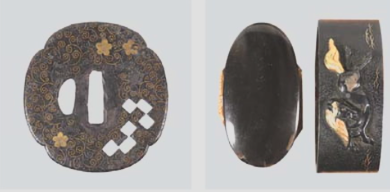
The koshirae is mounted with an attractive suite of Edo-period style fittings, including a dark patinated tsuba decorated with dense scrolling floral ornament and gilt blossom details. The guard retains visible hitsu-ana for side implements, contributing to its classical samurai mounting form. The accompanying fuchi is worked in relief with mixed-metal decoration and gilt highlights, presenting a refined naturalistic motif against a dark ground. The kashira is more restrained, with a smooth dark finish that complements the richer surface decoration of the tsuba and fuchi. Overall, the fittings create a balanced impression: ornate and elegant, but not overly flamboyant, with a refined antique character appropriate to a formal sword mounting.
The blade is housed in a finely finished black lacquer saya, executed in a deep gloss surface that provides a restrained and elegant presentation. The scabbard is mounted with decorative metal fittings showing relief-work detail and gilt highlights, depicting naturalistic motifs. The contrast between the plain black lacquer and the more ornate fittings gives the koshirae a balanced character, formal in appearance while still displaying refined craftsmanship.
Smith Biography:
Hida no Kami Ujifusa (飛騨守氏房) was a prominent Japanese swordsmith active from the late Sengoku through early Edo period (late 1500s–early 1600s). His blades are highly prized among collectors for both their craftsmanship and historical significance.
Background and Life
Ujifusa was born in Eiroku 10 (1567) in Mino Province as the son of Wakasa no Kami Ujifusa, himself a respected swordsmith in service to Oda Nobunaga. As a youth, he served as a page to Oda Nobutaka, Nobunaga’s third son, and followed him into battle during the campaigns in Kii Province. When Nobutaka was defeated by Toyotomi Hideyoshi and forced to commit seppuku in 1583, Ujifusa became a rōnin (masterless samurai) and later devoted himself fully to the craft of swordmaking under his father’s guidance and later under Nobutaka (the swordsmith, not the lord).
In Tenshō 20 (1592), he was granted the honorary court title “Hida no Kami” (Governor of Hida Province) by imperial decree, likely on recommendation from Toyotomi Hidetsugu, Hideyoshi’s nephew. He eventually settled in Owari Province (modern Nagoya) and became one of its foremost swordsmiths during the Shintō (new sword) period.
Swordmaking and Style
Hida no Kami Ujifusa belonged to what is known as the Owari Shintō School, which flourished after the fall of the Mino tradition’s dominance. Alongside Hōki no Kami Nobutaka and Sagami no Kami Masatsune, Ujifusa was considered one of the “Owari San Saku” — the Three Great Smiths of Owari.
His blades are known for:
- Stout, broad construction (mihaba)
- Shallow sori (curvature) and high shinogi
- Hamon (temper line): often ō-gunome midare, notare-gunome, or variations resembling Ise Muramasa’s dramatic style
- Hada (grain): finely forged ko-itame mixed with mokume and masame
- Steel activity like nie, nioiguchi, sunagashi, and kinsuji
Ujifusa’s swords were highly functional and artistically powerful—firmly built yet with vivid hamon patterns that reflected both precision and intensity. Many examples are NBTHK Tokubetsu Hozon or Tokubetsu Kicho certified, and his works are rated Wazamono (very sharp) and Jōsaku (high-level workmanship) by experts like Fujishiro.
Legacy
He remained active well into the early Edo period, likely retiring around 1631. His works are now among the most respected from the Owari region, both as art objects and as functional weapons. Some of his katana and wakizashi are valued at several million yen in collector markets.
Biography & Historical Context
Hida no Kami Ujifusa was born in 1567 and became a page of Oda Nobutaka — one of Oda Nobunaga’s sons — in 1577. His father, Wakasa no Kami Ujifusa (real name Kawamura Kyouzaburo, originally named Kanefusa), was born in 1534 in Gifu, Mino province. He was given the official title of Wakasa no Kami and subsequently won the praise of the daimyo Oda Nobunaga, exclusively serving him.
Ujifusa became a ronin when Nobutaka committed suicide after being ordered to commit seppuku during the Battle of Shizugatake in 1583. After that, he moved to Kiyosu Castle and began forging swords with his father. According to transmission, after the death of his father, he continued training under the Shodai Nobutaka.
In May 1593, he received the title of Hida no Kami from Toyotomi Hidetsugu, and moved to Nagoya Castle when the castle was completed. After the Nagoya castle restoration in 1610, he moved from Kiyosu to Kaji town, Nagoya (now in 3-chome Marunouchi, Naka-ku), and then retired in 1631. He yielded his position as head of the Ujifusa clan to his eldest son, the third generation Bizen no Kami Ujifusa, and passed away that same year at the age of 65.
The Owari Shinto School
During the Sengoku period, many swordsmiths moved from Mino to Owari and founded the Owari School, which enjoyed great prosperity in the ensuing Shinto period. Notable swordsmiths included Sagami no Kami Masatsune, Hoki no Kami Nobutaka, and Hida no Kami Ujifusa — considered the most representative swordsmiths for this school. These three are collectively known as the Owari San Saku (the Three Great Swordsmiths of Owari Province).
Hida no Kami Ujifusa was considered the best swordsmith of the Owari Shinto School.
Generations & Lineage
It seems there were generations of smiths in this line, including a first, second, and third generation Ujifusa. The second generation (nidai) is Bizen no Kami Ujifusa, and the third (sandai) is Hida no Kami — the same title as the first. The point of difference between the first and third generation is that in the latter, the fineness of the chisel marks in the mei (signature) is noticeable.
Blade Characteristics & Workmanship
Based on scholarly research by Tanobe Michihiro (Token Bijutsu, 1986), the defining characteristics of Ujifusa’s work are as follows:
Sugata (Shape): His extant works include katana, shinogi-zukuri wakizashi, hira-zukuri wakizashi, and tanto. Yari and naginata are rare. His kissaki are either slightly extended medium or large in size, and his sori is generally slight. Most of his mune are iori, with some mitsu exceptions. His wakizashi in hira-zukuri form are wide, largely in sunnobi size with saki-sori. His tanto are either long with modest sori or rarely very small with uchi-sori.
Kitae (Steel/Grain): The kitae is either itame with a coarse grain formation containing straight-grained areas, or tight itame with a whitish color. The itame hada is well grained with ji-nie and a zanguri (coarse) quality reminiscent of Kunihiro.
Hamon (Temper Pattern): His hamon is generally wide and forms squarish notare, mixed with a variation of a pointed form of gunome. Some examples are in o-notare containing ashi; others have typical gunome-choji patterns. His nioiguchi is cloudy and unclear, with the ha-buchi admirably covered with sometimes very coarse grains (ara-nie) placed irregularly. The grain activities in the ha are subdued and inconspicuous. Nie-deki gunome midare with hako (box) gunome mixed in is also characteristic. The hamon begins in a gentle notare yakidashi and becomes gradually wider through the length of the blade. Kinsuji and inazuma are present and especially active in the monouchi, with fine sunagashi and ashi.
Boshi (Point Area): The boshi takes different forms — midare-komi with a pointed tip resembling a mishina boshi, or ko-maru. Very rarely ichimai without kaeri is utilized. Most of his boshi have a long kaeri.
Nakago (Tang): The nakago tip is kurijiri shaped and has sujikai yasurime.
Overall Style: The katana he made have a wide body; the hamon is notare midare with a violent style that is reminiscent of Ise Muramasa.
Signatures (Mei)
Known signatures include: UJIFUSA, HIDA NO KAMI FUJIWARA UJIFUSA SAKU, and HIDA NO KAMI UJIFUSA.
Rankings & Appraisals
Ujifusa is among the most highly ranked Shinto period smiths across all major appraisal systems:
- Ranked Jo Saku by Fujishiro, valued at 5 million yen in the Toko Taikan, and listed as Wazamono (exceptionally sharp) by the Yamada family.
- Hawley’s ranks Hida no Kami Ujifusa very high at 80+ points.
- Some individual blades have been ranked as high as Jyo-jyo saku (the second-highest tier) in specialized appraisals.
The Wazamono designation is particularly significant, as it refers to blades certified for outstanding cutting performance based on test-cutting records maintained by the Yamada family of executioners.
Authentication & Collecting
Ujifusa blades are actively authenticated by the NBTHK (Nihon Bijutsu Token Hozon Kyokai), with surviving pieces receiving ratings of Hozon, Tokubetsu Hozon, and in some cases being considered candidates for the prestigious Juyo Token designation. Authenticated examples are considered candidates for Juyo Token status due to their flawless condition and historical significance.
Legacy
Hida no Kami Ujifusa represents the apex of the Owari Shinto tradition — a smith whose biography is inseparable from the turbulent final decades of Japan’s Sengoku era. His blades reflect both the practical demands of close-quarters infantry warfare and an emerging aesthetic refinement that would define early Edo period swordsmanship. His lineage continued for at least three generations, and his work remains actively collected and studied by nihonto scholars and enthusiasts worldwide.