
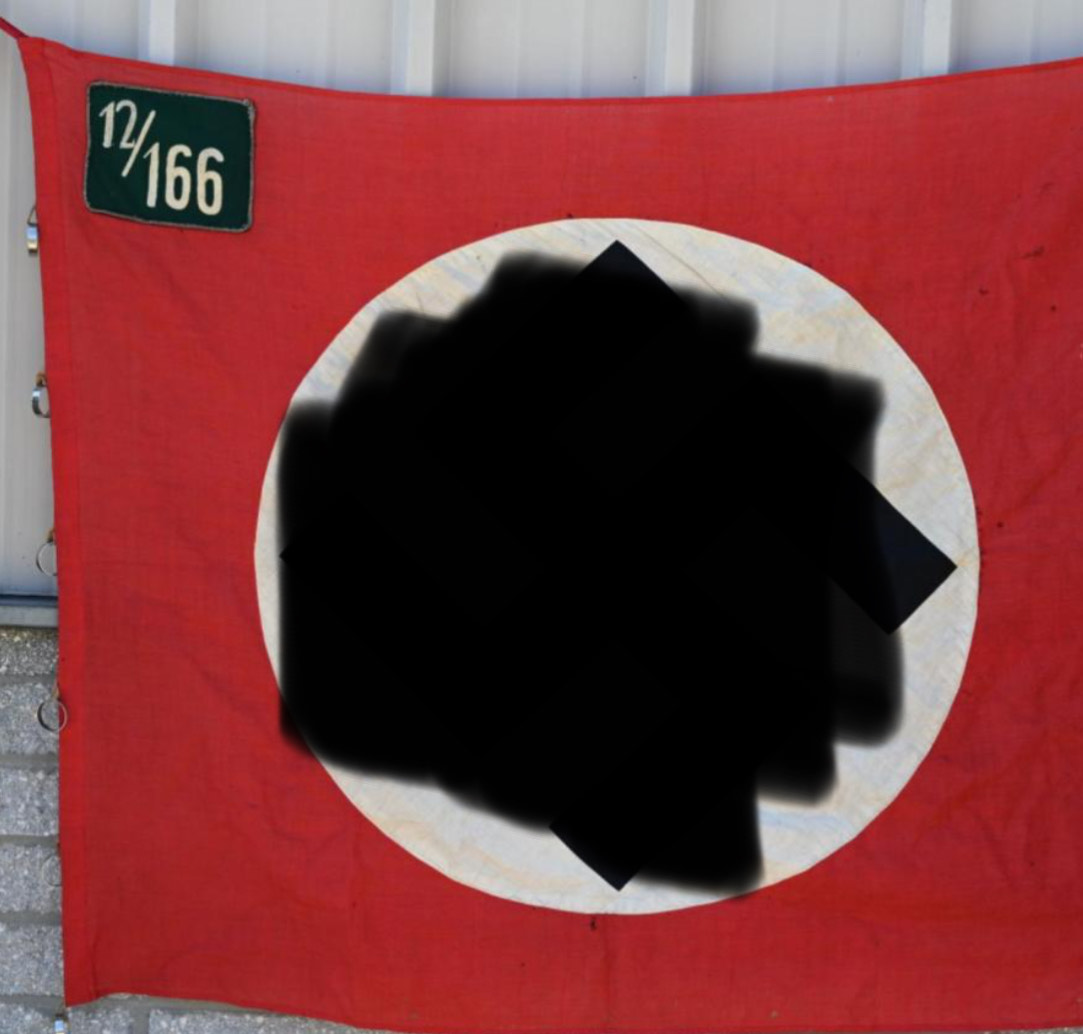


WWII German SA Sturmfahne – Unit 12/166 (Sturmabteilung Flag)
$2,600.00 CAD
WWII German SA Sturmfahne – Unit 12/166 (Sturmabteilung Flag)
This is an original WWII-era Nazi German SA Sturmfahne (Storm Unit Flag), representing Sturm 12 of Standarte 166. The flag is constructed of red wool bunting with a white sewn-on roundel bearing a black multi-piece cotton swastika, all stitched in the period-correct method consistent with 1930s and early-war production.
In the upper hoist corner, the identifying unit patch is machine-stitched to the field, featuring “12/166” in white chain-stitched numerals on a green wool background, bordered by twisted silver cord edging. This indicates the flag belonged to Sturm 12 (Company 12) of SA Standarte 166, the local SA regiment designation. Each Standarte typically corresponded to a regional headquarters, and each Sturm was a subordinate company-sized formation.
The flag retains its original bunting edge with leather-reinforced hoist loops and metal fittings, consistent with official SA flag manufacture under RZM (Reichszeugmeisterei) standards. Dimensions and construction are in keeping with flags carried during parades, rallies, and formation events.
Symbolism and Use
The SA Sturmfahne served both ceremonial and organizational purposes within the Sturmabteilung (SA), the paramilitary wing of the Nazi Party. Each Standarte possessed multiple Sturm flags, all bearing the same central swastika motif but differentiated by unit numeration. These banners were displayed during local rallies, marches, and formations, symbolizing the unity and pride of each unit within the Party’s hierarchy.
Consecration Process (“Fahnenweihe”)
All official SA and NSDAP formation flags underwent a formal consecration ritual known as “Fahnenweihe” (flag dedication ceremony). During these ceremonies—often conducted at large Party rallies or regional gatherings—high-ranking SA or Party officials presented the new flag to its assigned unit.
A senior leader would touch the new flag to the “Blutfahne” (Blood Flag)—the original banner carried during the failed 1923 Munich Putsch and considered a sacred relic of the movement. This symbolic act was believed to sanctify the new flag, binding it to the Party’s earliest history and fallen comrades. Each consecrated flag thus carried immense ideological significance, representing both the spirit of the SA and its loyalty to the Führer.
Historical Context
By the mid-1930s, SA Standarte flags like this one were a central part of Nazi visual and ritual culture. While the SA’s influence waned after the “Night of the Long Knives” (1934), its organizational banners remained in use through the war years in ceremonial and propaganda contexts.
Flags marked with numerical designations such as 12/166 provide valuable insights into regional organization and deployment, often corresponding to specific German towns or districts. Surviving examples are highly sought after due to their rarity, craftsmanship, and direct connection to the paramilitary and political structure of the Third Reich.
Specifications
-
Period: Circa 1933–1945
-
Type: SA Sturmfahne (Storm Unit Flag)
-
Materials: Red wool bunting, cotton roundel and swastika, chain-stitched wool numerals, twisted cord trim, leather hoist fittings
-
Unit: Sturm 12 / Standarte 166
-
Dimensions: Approx. 1.2m x 1.4m
-
Condition: Very good overall; light toning to white field, minor wear from age and handling, consistent with genuine field or parade use