
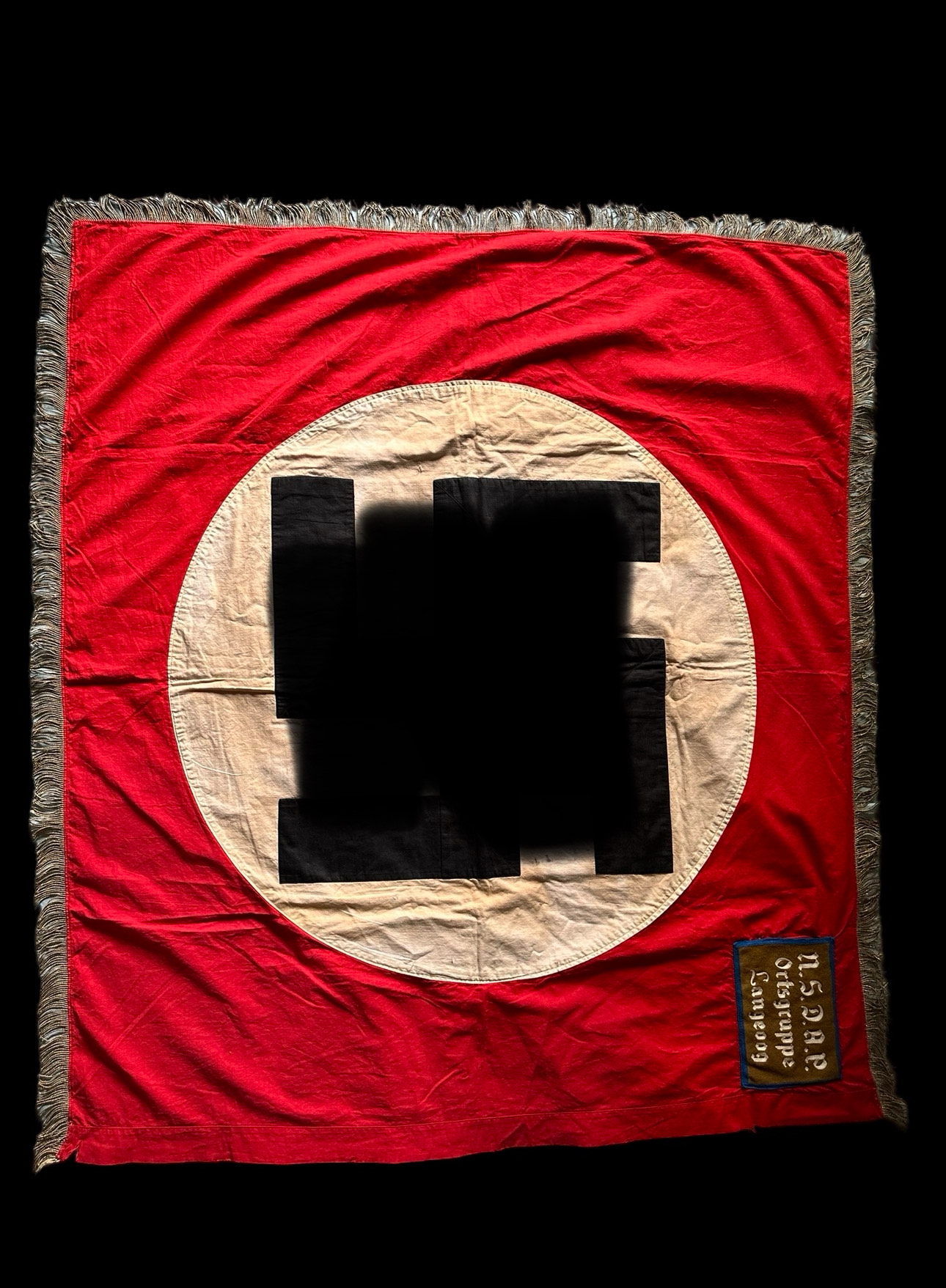
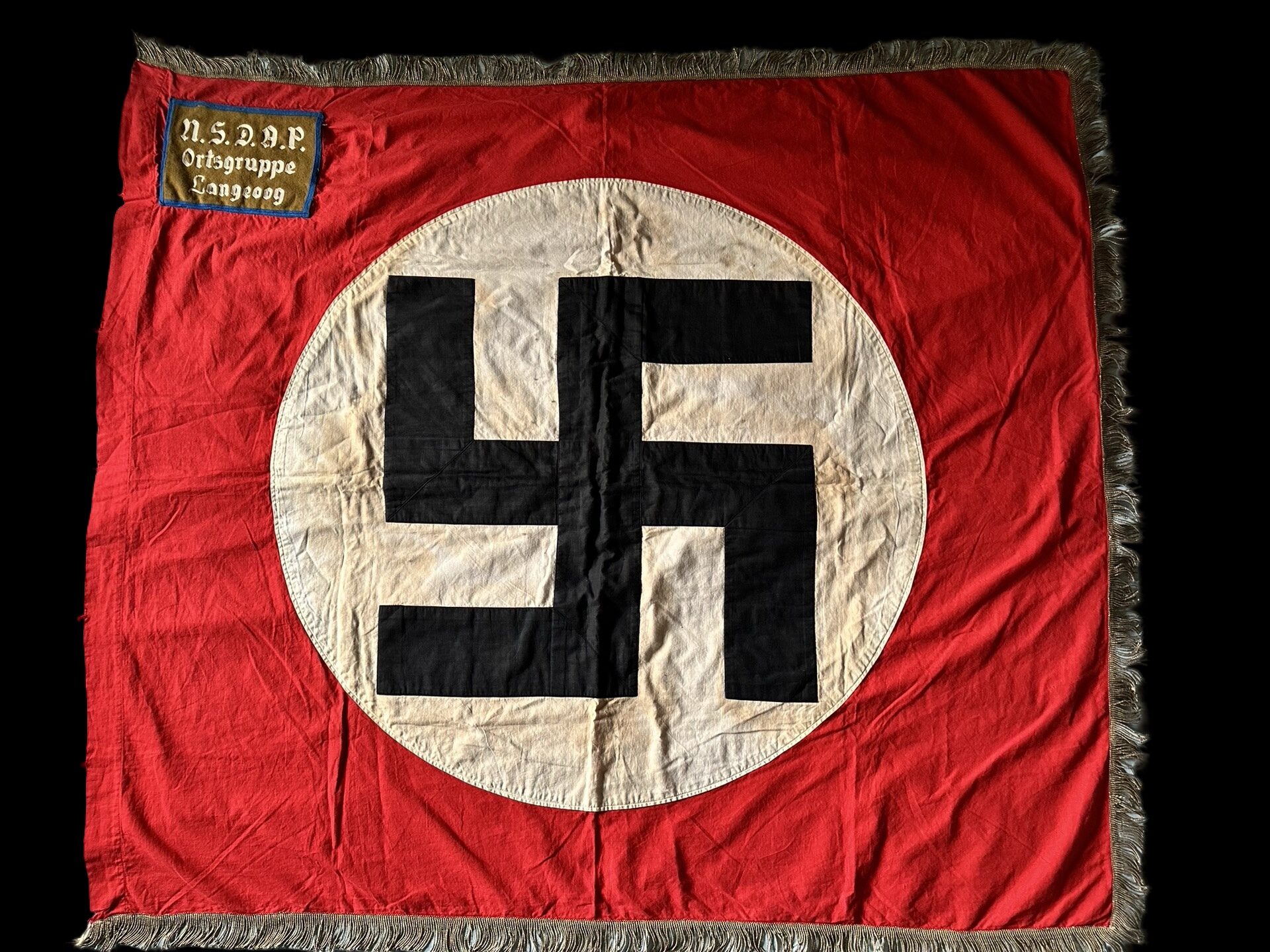
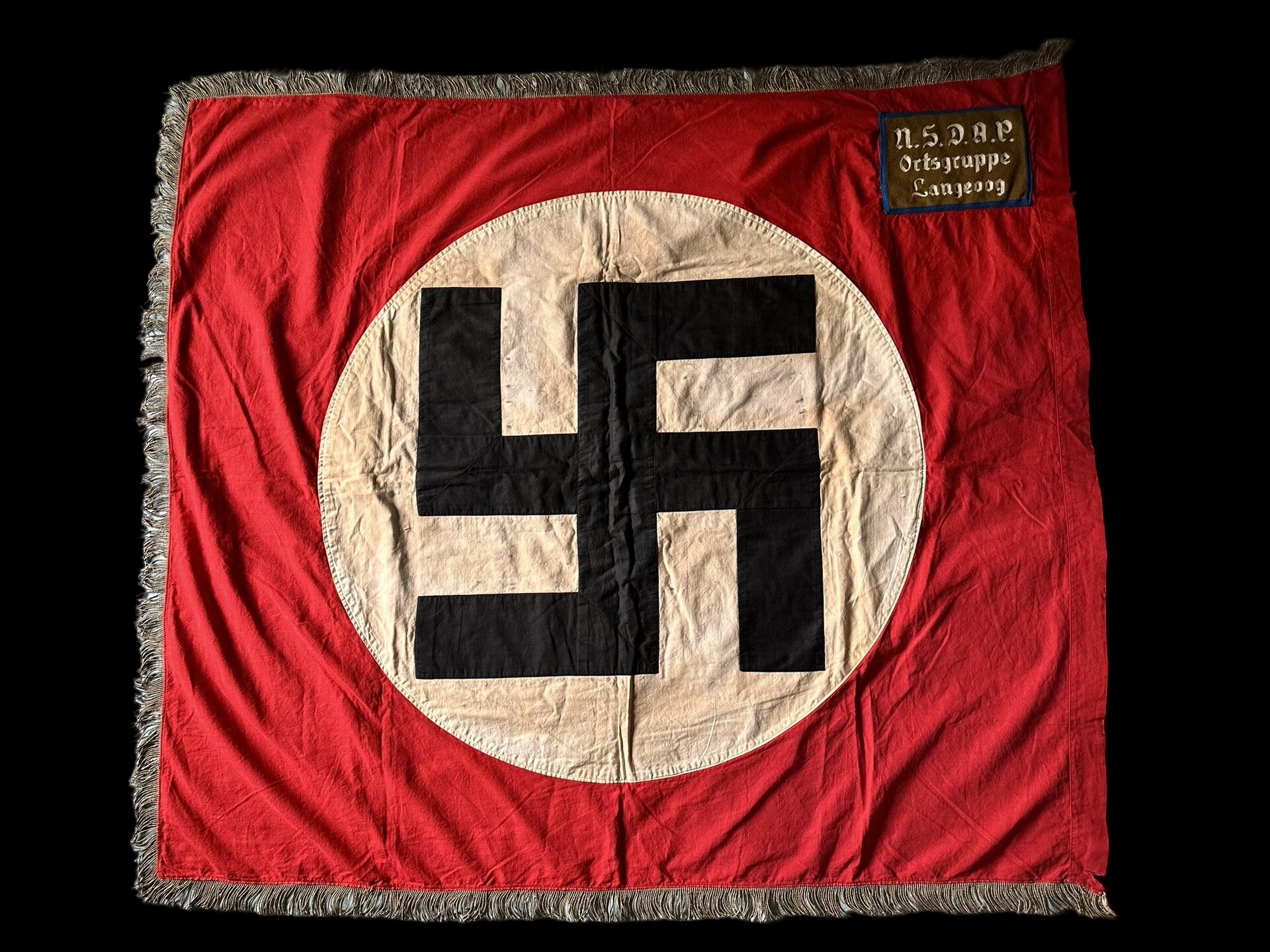
WW2 German Flag Third-Reich N.S.D.A.P. Ortsgruppe district standard
$3,100.00 CAD
German Third-Reich N.S.D.A.P. Ortsgruppe district standard. These were consecrated by Adolf Hitler at Nuremburg and also by the Deutchland Erwache Standarte, more on the consecration process below. Large Flag: Overall 50″ x 54″
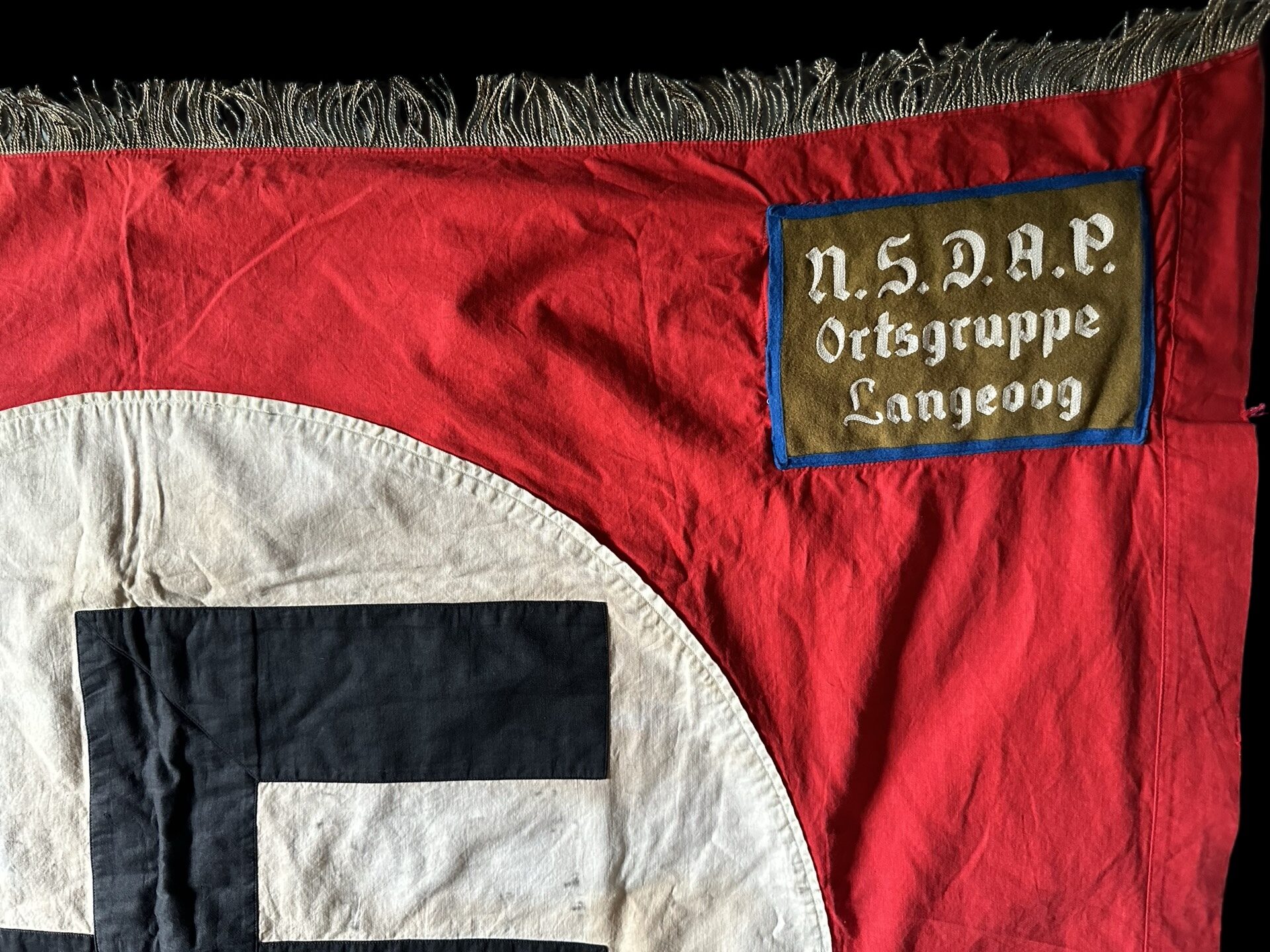
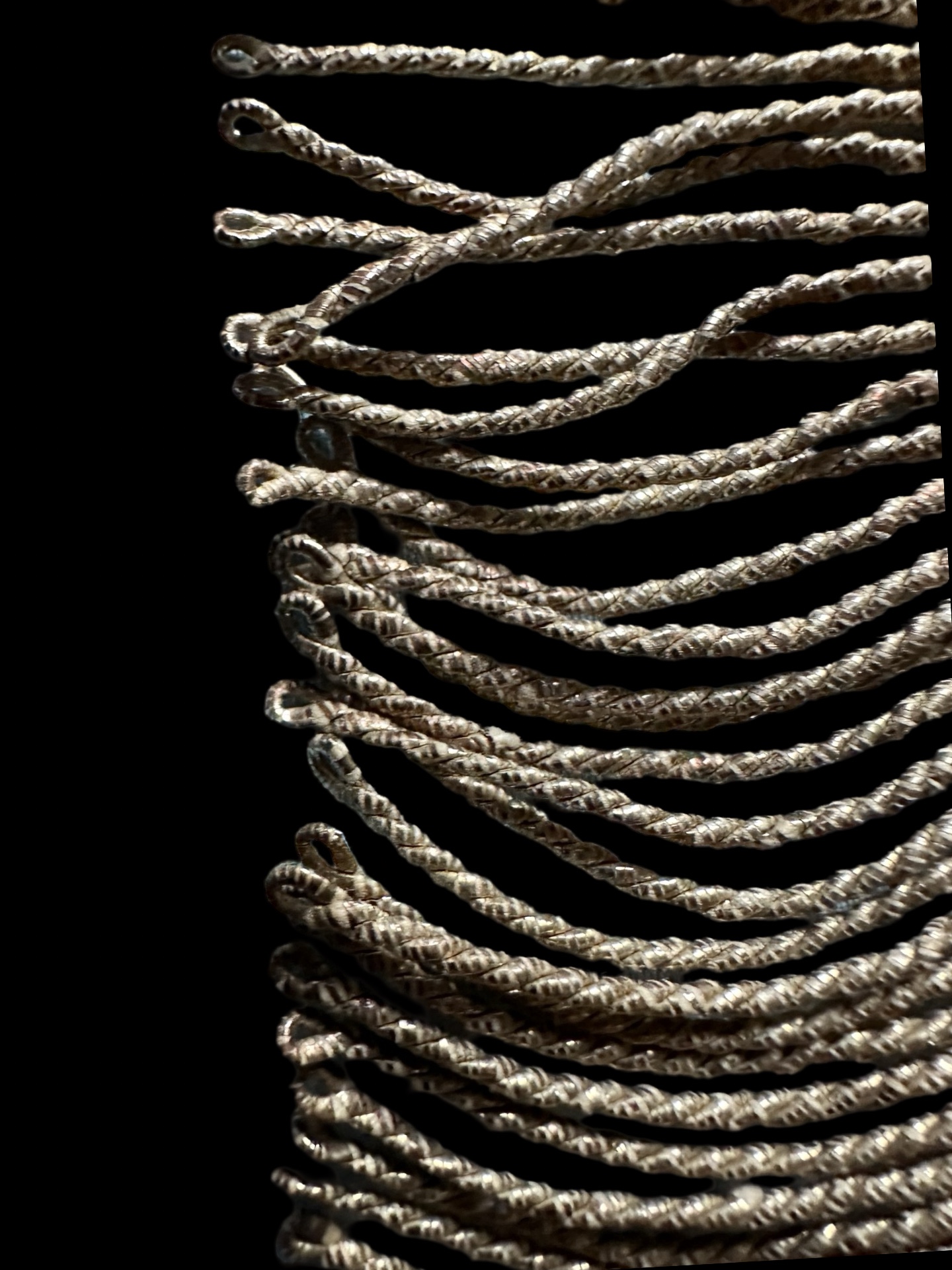
4 5/8″ wide arms on the vertical black swastika sewn to the 34 1/4″ diameter white circle – sewn to the red field. Blue outlined 6″ x 8 1/2″ brown upper corner patch with white lettering “N.S.D.A.P. Ortsgruppe Langeoog”. Also, on the reverse side. 1 3/4″ silver fringe on three sides. A rare early Party flag.
Ortsgruppe Flag and Consecration Process Info:
The NSDAP Ortsgruppe flags were used by local branches of the Nazi Party (NSDAP) to represent their specific groups. These flags featured the Nazi swastika, along with additional symbols or text to denote the specific Ortsgruppe (local group). They played a significant role in rallies, parades, and other public events.
A notable aspect of the Nazi flag consecration process involved the Blutfahne (“Blood Flag”).
The consecration ceremony was highly ritualized. During mass rallies like the annual Nuremberg rallies, newly made Nazi flags, including Ortsgruppe flags, would be brought to a public event where the Blutfahne was present. The process involved the Blutfahne being touched or waved over these new flags, symbolically “blessing” them. This act was meant to link the new flags and groups to the party’s early struggles and to the supposed sacrifice made by its martyrs. The ritual imbued these flags with a sense of sacredness, loyalty, and continuity within the Nazi movement.
The Blutfahne was treated almost like a holy relic, and the ceremony was orchestrated to reinforce loyalty to the Nazi cause through symbolism, pageantry, and historical connection.
The consecration of the NSDAP Ortsgruppe flags, was a highly symbolic and ritualized process during the Nazi regime, centered around the Blutfahne (“Blood Flag”). This flag, tied to the failed 1923 Beer Hall Putsch, was treated as a sacred relic. The consecration ceremonies, known as Fahnenweihe (flag dedication), were an essential part of Nazi rallies, particularly at large gatherings like the Nuremberg rallies. Here’s a detailed explanation of the process:
Historical Background of the Blutfahne
The Blutfahne gained its significance during the Beer Hall Putsch in Munich, an attempted coup by Adolf Hitler and the Nazi Party to overthrow the Weimar Republic. During the street confrontation with police, several Nazi supporters were killed, and the flag they carried was reportedly stained with their blood. The Nazis later used this flag as a symbol of martyrdom, and it became a powerful emblem of the Nazi struggle and their fallen “heroes.” The flag was preserved and displayed at Nazi rallies as a symbol of their early sacrifices.
The Consecration Process (Fahnenweihe)
Selection of New Flags: Local Nazi Party branches (Ortsgruppe), paramilitary organizations like the SA (Sturmabteilung) or SS (Schutzstaffel), and other affiliated groups would commission new district level flags. These flags bore the swastika and other identifying symbols of the group such as the “NSDAP + District Name” Patch.
Nuremberg Rallies and Other Ceremonies: The most prominent consecration ceremonies took place at the annual Nuremberg rallies. Although smaller, localized ceremonies could also occur where Ortsgruppe flags would be consecrated by the Deutchland Erwache flag. At the large-scale Nuremburg events, Adolf Hitler and other high-ranking Nazi officials would preside over the proceedings, imbuing the ceremonies with an air of national significance.
The Procession: At the start of the ceremony, the new flags were paraded in front of the attending Nazi leadership and large crowds of supporters. The Blutfahne would also be present held by an SA officer, oftentimes. the flag was handled by Jakob Grimminger(more info on him down below), an SS officer who was given the honor of caring for the Blutfahne.
Invocation of the Blutfahne: In a solemn and almost religious manner, the new flags would be brought before the Blutfahne. The Blutfahne was regarded as the embodiment of the Nazi Party’s struggle and the blood sacrifice of their fallen comrades. Its presence was meant to consecrate or “bless” the new flags with the symbolic connection to this sacrifice.
The Act of Consecration:
The Blutfahne was physically touched to the new flags, usually by Hitler himself at the large ceremonies, during a flags life, it would be at these ceremonies multiple times. This act was seen as transferring the symbolic power, blood, and memory of the Nazi martyrs to the new flags.
In some ceremonies, Hitler would personally lay his hands on both the Blutfahne and the new flags, further intensifying the ritual significance. This moment of contact was the high point of the ceremony, seen as a way to legitimize the new flags and symbolically induct them into the Nazi “community.”
Oaths of Allegiance: Following the consecration, leaders of the local groups or military units that received the new flags would often swear oaths of loyalty to Hitler, the Nazi Party, and the “martyrs” of the Beer Hall Putsch. This ritual oath, combined with the consecration, was designed to cement ideological and personal loyalty to the regime.
Symbolic Power of the Flags: Once consecrated, the flags were treated with a quasi-religious reverence. They were used in parades, rallies, and other public displays as symbols of the local group’s loyalty to the Nazi movement. They were also brought to official party events to underscore the group’s place within the larger Nazi hierarchy.
Symbolism and Ideology
The consecration process was a powerful blend of Nazi mythology, symbolism, and militaristic pageantry.
It was designed to:
Create a Sense of Sacred Duty: By linking the new flags to the Blutfahne, the Nazis fostered the idea that their cause was sanctified by the blood of fallen comrades, elevating their political ideology to a near-religious level.
Reinforce Loyalty: The ceremonial acts of touching the Blutfahne and swearing oaths were meant to reinforce personal loyalty to Hitler and the Nazi Party. It underscored the belief that the Party’s political struggle was a continuation of the sacrifices made during the early years of the Nazi movement.
Ritualistic Pageantry: The public nature of these ceremonies and their highly orchestrated format helped build a sense of community and belonging among Nazi supporters. They were carefully crafted to evoke emotion and loyalty through ritual.
Final Symbolic Importance
The Blutfahne ceremonies served as a form of political “sacrament” for the Nazis, a fusion of their ideology with quasi-religious reverence. The consecration of flags through the Blutfahne not only strengthened the mythos of Nazi martyrdom but also embedded Nazi symbols with deep emotional and ideological power for their followers.
*The Blutfahne itself disappeared after the fall of Nazi Germany in 1945, and its whereabouts remain unknown to this day, adding to its enduring myth as one of the parties most important symbols.
Island of Langeoog Ortsgruppe Short History:
The Ortsgruppe Langeoog was the local Nazi Party group on the small German island of Langeoog in the North Sea, part of the East Frisian Islands. Like other Ortsgruppen (local groups), its purpose was to establish and maintain Nazi control over local communities, ensure party policies were implemented, and oversee the population’s adherence to Nazi ideology.
General Information about Ortsgruppen
- Role and Structure: Ortsgruppen were the smallest unit of the Nazi Party’s administrative structure. Each Ortsgruppe was responsible for a specific geographic area, usually covering towns, neighborhoods, or rural communities. They reported to regional (Kreis) leaders, who in turn were connected to higher-level Gauleiter (regional leaders).
- Leadership: An Ortsgruppenleiter (Local Group Leader) led each Ortsgruppe and was responsible for the political education of the population, organizing party activities, and maintaining local control. These leaders worked closely with the party’s paramilitary organizations (SA, SS) and local government officials to enforce party directives.
- Functions: The Ortsgruppen promoted Nazi policies through propaganda, organized rallies, collected membership dues, and kept records on party members and sympathizers. They also played a role in distributing ration cards during wartime and organizing local elections to ensure Nazi dominance.
Langeoog under Nazi Rule
- Langeoog’s Strategic Importance: Langeoog, as part of the East Frisian Islands, was located in a region of strategic importance for the defense of Germany’s northern coastlines. During World War II, the island, like others in the region, was fortified as part of the Atlantic Wall, a system of coastal defenses built by Nazi Germany to protect against an Allied invasion.
- Military Presence: During the war, Langeoog had a significant military presence, including anti-aircraft batteries and other coastal defenses. The island’s small population and isolated location made it a quiet but strategic outpost.
- Nazi Influence on the Island: The Ortsgruppe Langeoog, like other local groups, would have played a role in maintaining control over the island’s population, ensuring loyalty to the Nazi Party, and managing wartime responsibilities. The Ortsgruppenleiter would have coordinated with military authorities and ensured that the island’s residents supported the war effort through labor, rationing, and civil defense.
After the war, like most Nazi institutions, the Ortsgruppe Langeoog was dissolved. The island returned to civilian administration and became a popular tourist destination in post-war Germany.
The island of Langeoog, along with the other East Frisian Islands, was liberated by Canadian forces in May 1945 during the final stages of World War II. Specifically, elements of the Canadian 4th Armoured Division and supporting units played a role in securing the region.
The liberation of Langeoog and the surrounding islands was part of a broader operation to clear the northern Netherlands and coastal areas of Germany from Nazi control. This operation included the clearing of the Frisian Islands, which were still occupied by German forces even as the mainland fell to the advancing Allies.
In the case of Langeoog, the German garrison on the island surrendered to the Canadian forces without significant fighting. The island’s isolated position and the general collapse of German defenses in the region led to a relatively peaceful handover.
The Canadian 4th Armoured Division and other Canadian units were part of the First Canadian Army, which was heavily involved in the liberation of the Netherlands and the northern German territories.
Jakob Grimminger became the Blutfahne (Blood Flag) bearer for the Nazi Party due to his involvement in the early years of the party and his participation in the 1923 Beer Hall Putsch, which gave the Blutfahne its symbolic significance.
Background:
- Early Life and Military Service: Jakob Grimminger was born on April 25, 1892, in Augsburg, Germany. He served in the Imperial German Army during World War I, primarily in the Ottoman Empire, which gave him military experience. After the war, like many disillusioned veterans, he became involved in nationalist and paramilitary groups that would later coalesce around Adolf Hitler’s Nazi Party.
- Joining the Nazi Party: Grimminger joined the Nazi Party (NSDAP) in the early 1920s and became a member of the Sturmabteilung (SA), the Nazi Party’s paramilitary wing. His loyalty and early involvement with the SA placed him close to key events and figures in the Nazi movement.
Role in the Beer Hall Putsch:
- The 1923 Beer Hall Putsch was an attempted coup by Adolf Hitler and the Nazi Party to overthrow the Weimar Republic in Munich. Grimminger participated in this failed coup, which resulted in the deaths of several Nazi supporters and became a crucial moment in the party’s mythology.
- During the putsch, one of the flags carried by the Nazis was stained with the blood of the fallen marchers, which included SA men like Andreas Bauriedl. This flag, later known as the Blutfahne (Blood Flag), became a powerful symbol of martyrdom and sacrifice within the Nazi Party.
Becoming the Blutfahne Bearer:
- SA Leadership and Role: After the putsch, despite its failure, Hitler and the Nazi Party used the event as a propaganda tool, elevating the status of those who had fallen. The flag stained with their blood was preserved and became one of the most sacred symbols of the Nazi movement.
- Grimminger, due to his involvement in the putsch and his trusted position within the SA, was selected to be the official bearer of the Blutfahne. His role as the flag bearer was both ceremonial and symbolic. He carried the flag at important Nazi rallies, including the annual Nuremberg rallies, where it was used to consecrate new party flags during the elaborate Fahnenweihe (flag consecration) ceremonies.
- Reverence of the Role: Carrying the Blutfahne was a significant honor within the Nazi Party. Grimminger’s role as its custodian made him a visible figure at major Nazi events, symbolizing the link between the Party’s early struggles and its later success. His task was to carry the Blutfahne during the consecration of new Nazi flags, touching it to them to symbolically transfer the “blood sacrifice” of the Nazi martyrs to the new banners.
Post-War Fate:
After the collapse of Nazi Germany in 1945, Grimminger was arrested and interrogated by Allied forces. He was not tried for war crimes, as his role was largely ceremonial, and he returned to civilian life in West Germany. He lived a quiet post-war life, largely fading from public view. The Blutfahne itself disappeared after the war and has never been recovered, adding to its mythic status.
Grimminger passed away in 1969, having lived out his post-war years in obscurity.